
Economic Evaluation of Standalone Hybrid PV–H2 with Storage System
June 7, 2025
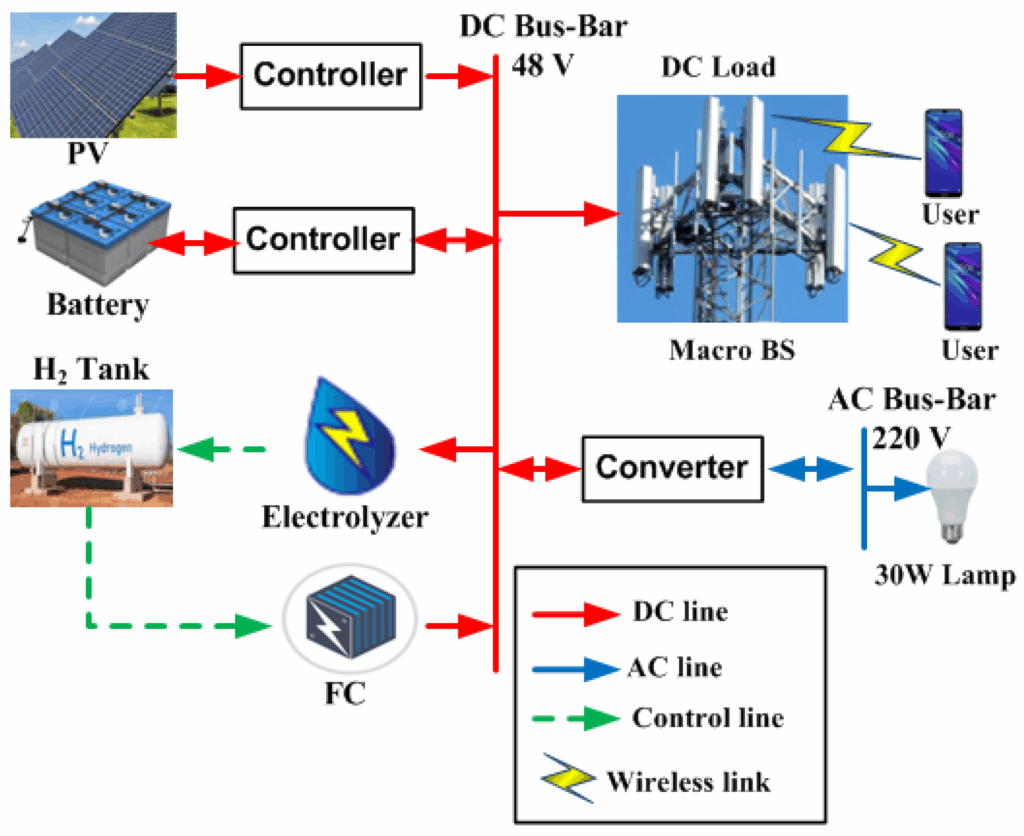
This study evaluates the economic performance of a standalone
hybrid PV-H2 system with battery storage for small-scale electricity demand.
The methodology involves comparing various configurations of standalone
PV, storage, and hybrid PV-H2 systems under different discount rates and
evaluation periods. Economic indicators such as Net Present Value (NPV),
Payback Period, and Discounted Annualized Return (AAR) determine
financial viability. Results indicate that the PV-H2 system with two days of
storage offers the most favorable economic performance despite not being
the best technical solution. Sensitivity analysis further supports the
robustness of the proposed model. This study highlights the potential of
hybrid PV-H2 systems to provide sustainable and cost-effective energy
solutions, especially in remote and off-grid locations.
Energy storage using a battery is increasingly preferred. However, studies have shown that the ability of a battery to store energy is limited. The battery needs to be installed on the standalone system to be higher to store more energy. Besides, the battery has weaknesses that can cause environmental pollution problems (Hosseini and Wahid, 2020). However, hydrogen gas is clean and environmentally friendly; renewable energy can store more considerable energy (Dawood et al., 2020). Hence, the hybrid system using a standalone PV-H2 system is more cost-effective for standalone operation. A standalone PV system using this hybrid energy has the advantage that more reliable energy is provided and is more efficient than using a standalone system fed by a PV system alone with a storage battery system of the same rating (Nasser et al., 2022). A DC-DC inverter has been invented to produce hydrogen gas from solar modules. Although the invention has some advantages while working, its initial cost is relatively expensive. There are some disadvantages and solutions to problems in standalone. PV uses hydrogen fuel cell systems, as described in the discussion section. Using Photovoltaic (PV) modules, solar energy is an essential and accessible source. The standalone Photovoltaic (PV) system provides energy everywhere, especially where the electricity power distribution network coverage is unavailable (Barhoumi et al., 2022). A problem occurs because the electricity produced by PV modules is not constant and reliable. In such cases, a standalone system alone cannot provide continuous and reliable energy. There is one reported study of a standalone PV system using hybrid energy for the remote microwave repeater. The solutions to end the problem of unwavering solar radiation are to store the excessive electricity produced during the previous days, function with a diesel generator system, and use a Photo Electrochemical (PEC) process to make hydrogen gas. Background and Rationale The first difference concerning other research focused on the same topic was the energy storage implementation, which is fundamental in an off-grid facility without a robust monitoring system and usually outside contractual services (Gerlach and Bocklisch, 2021). We considered a hydrogen storage bank of reduced capacity, dimensioned according to the designer’s preference expressed by mixing different storage strategies and working cycles. Such banks can modify the load profile and reduce the shortcomings, possibly reducing the storage volume and tank pressure (Crespi et al., 2021). These are the days of sustainable and distributed generation, led by Photovoltaic (PV) systems, possibly coupled to electrolyzers for direct production of Hydrogen (H2) gasinstead of injection only within Power-to-Gas systems (PtG). Such a combination has been extensively analyzed and economically evaluated, but for power plants much larger than a typical load size and with typically no energy storage capacity due to the continuous H2 production (Gutiérrez-Martín et al., 2024). The present work was motivated to evaluate the expected behavior for standalone hybrid PV–H2 systems in a standalone small grid, characterized by household, commercial, and industrial loads located in an off-grid facility, i.e., one that is experiencing several problems for connection and that anyway is interested in preferring emission-free solutions (Monforti Ferrario et al., 2021).
In this section, a standalone hybrid PV-H2 system with battery storage economic analysis is executed for the town of Aydın. Six different scenarios were considered to find the best system. In the first scenario, standalone PV is executed and then an economic analysis of standalone storage systems is performed. In the third scenario, the standalone PV and the battery system are operated, followed by the PV-H2 configuration. After evaluating optimization models, the economic evaluation of PV-H2 with storage is made to choose the best system. The performance and optimization of the system for the best result have been executed for 21 years. A discount rate of 5, 10, and 5% was considered for obtaining discounted AARs for the payback periods, annualized life-cycle costs, and levelized electricity costs at the end of the 5th, 12th, and 21st years